 Get The Full Toolkit
What If Challenging Behaviors Became Your Competitive Advantage?
Most child care centers see challenging behaviors as a daily struggle. The most successful centers use the right systems to build stronger teachers, reduce staff burnout, increase consistency, and become the center families trust and recommend.
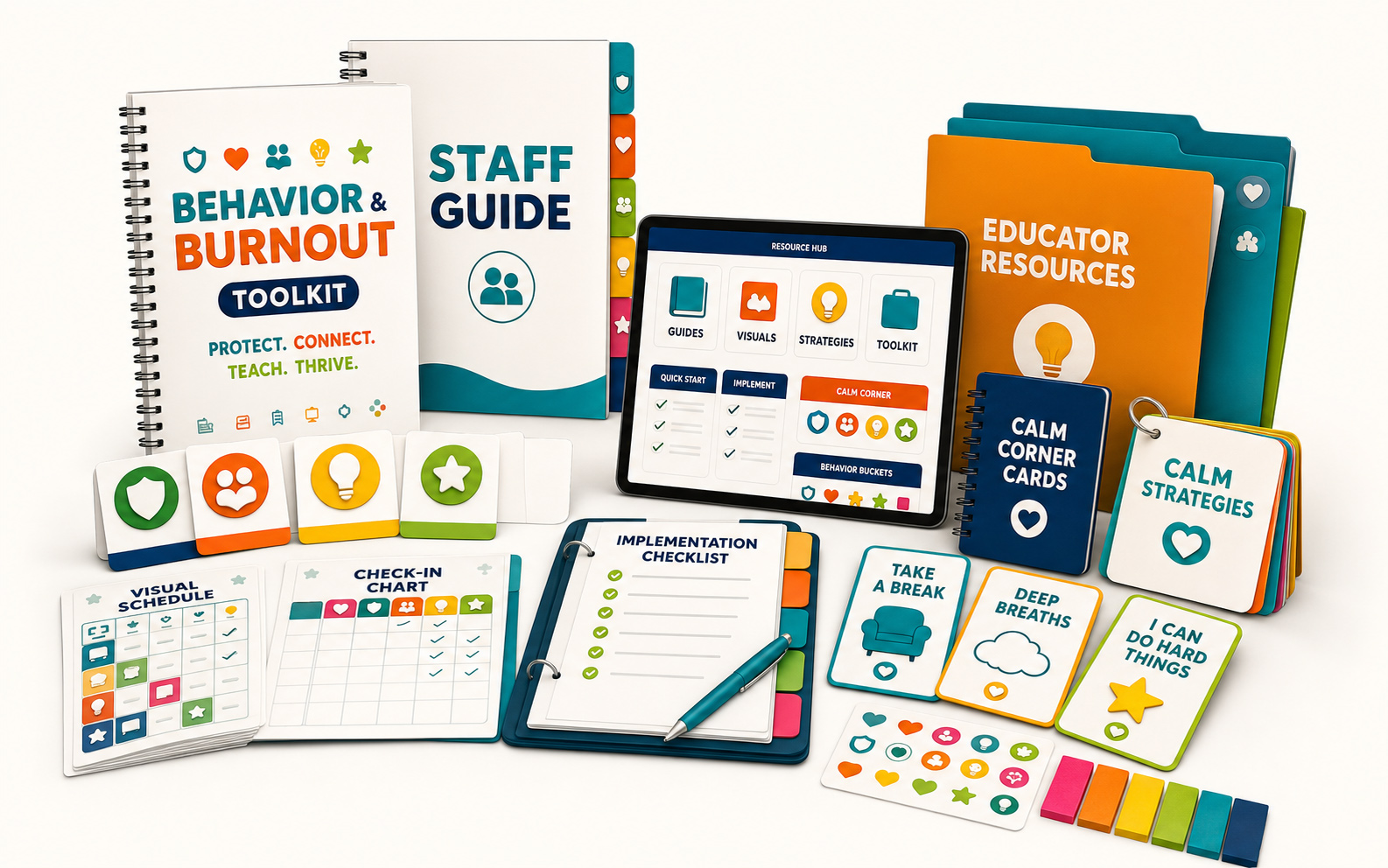
A Look Inside The Toolkit
Real pages, cards, and visuals from the Behavior & Burnout Toolkit.
The Real Cost Of Challenging Behaviors
Challenging behaviors don’t just affect the children in your classroom. They affect the teachers supporting them every day.
Without practical systems, teachers become overwhelmed. Burnout increases. Great teachers leave.
Children lose the consistency they need, and families begin to lose confidence.
Directors spend more time hiring than growing their center.
It becomes a cycle that impacts every part of your business.
Now Imagine A Different Story
Imagine teachers staying because they feel supported instead of overwhelmed.
Calmer classrooms and consistent relationships give children the support they need to grow.
Families confidently recommend your center because they can see your team has a plan.
Spend less time replacing staff and more time building the center families trust.
One Toolkit. One System. One Stronger Center.
Instead of every classroom figuring it out alone, your entire team follows the same practical, evidence-based approach.
Before The Toolkit
- Staff wonder what to do.
- Teams react in the moment.
- Leaders search for answers.
- Every classroom does something different.
After The Toolkit
- Teachers know where to start.
- They understand what behavior communicates.
- Everything they need is organized in one place.
- The whole team follows one practical system.
A Simple Behavior Path Your Team Can Remember
Each step is built around the real decisions staff need to make when behavior is happening.
Look at what is happening, when it happens, and what the child may be communicating.
Help the child and the adult get calm enough for the next step to work.
Replace constant correction with simple skill-building supports and routines.
An organized digital hub that keeps the full toolkit easy to find and easy to use.
A practical way to look at patterns, triggers, needs, and next steps before jumping into discipline.
A simple shared language for safety, regulation, participation, and social-emotional needs.
Quick visual references that help staff understand common challenging behaviors and what may be underneath them.
One-page staff guides for what to say, what to do, what to teach, and how to follow up.
Matching family-facing guides that make home-school communication easier and more consistent.
Infant and toddler supports for co-regulation, feelings, simple visuals, and family education.
Calm corner tools, strategy cards, feelings supports, activities, and classroom regulation routines.
Visual boards, token boards, routine cards, reward cards, blank planning pages, and printable classroom supports.
Reset routines, reflection tools, wellness supports, and simple systems for hard classroom days.
This Isn’t Another Printable Bundle
It’s a complete behavior support system built to strengthen teachers, classrooms, families, child outcomes, and the center families trust.
Extra Support To Help Your Team Actually Use It
These launch resources help leaders roll the system out quickly and keep staff moving.
A simple launch path so your team knows where to start first.
Use it to organize staff support, classroom expectations, and next-step follow-up.
Plain-language prompts for difficult behavior conversations.
Built For Programs That Need Practical Behavior Support Now
This is for early childhood leaders who want a ready-to-use support system, not another vague training binder.
What Is The Cost Of Not Having A Plan?
When behavior support is missing, the cost does not always show up as one big bill. It shows up as staff turnover, parent complaints, classroom stress, safety concerns, and children escalating because the adults do not have a shared system.
When behavior support feels like constant survival, strong teachers burn out faster and programs pay for it through churn, retraining, and lost classroom consistency.
Without a clear plan, the same behavior keeps escalating: biting, hitting, elopement, injury reports, emergency calls, and days that feel out of control.
Parents notice when behavior feels unmanaged. One hurt child, one unclear update, or one repeated incident can turn into complaints, withdrawals, and reputation damage.
Instead of leading the program, directors become the default behavior plan. That drains leadership capacity and keeps the same problems coming back.
What Would It Cost To Build This Yourself?
Hours of research. Multiple resource purchases. Staff training time. Consultant support. Endless searching for tools that actually fit together. The toolkit brings the essential pieces into one organized, ready-to-use behavior support system.
Better Systems. Better Teachers. Better Outcomes.
When teachers know what to do, they stay. When teachers stay, children experience consistency. When families notice that consistency, your reputation grows.
Simple Answers Before They Buy
Is This Only For Severe Behavior?
No. It is built for everyday early childhood behavior support, including common classroom challenges that drain staff over time.
Can New Staff Use This?
Yes. The guides are written to be simple, visual, and practical enough for new and experienced educators.
Is This A Course?
No. This is a toolkit and resource system. The goal is fast implementation, not another long training staff never finish.
Can I Use This Across Multiple Classrooms?
Yes. It is designed as a shared program support system for childcare centers, preschool teams, and early learning programs.
Give Your Team The System They’ve Been Missing
Stop guessing. Start responding with confidence. Build calmer classrooms, stronger teams, and a center families trust.
Get Instant Access For $97